


医科学専攻
- Master's Courses
修士課程 - Doctoral Courses
博士課程
Advanced Pediatric Medicine (National Center for Child Health and Development) 次世代小児医療講座 / 小児生理学研究部(国立成育医療研究センター)
STAFF
Professor
-
Mori, Masaki Professor. 森 雅樹 客員教授
CONTACT
TEL:+81-3-3416-0181
E-MAIL:mori-ma*ncchd.go.jp
(「*」を「@」に変換してください)
OUTLINE
Our laboratory, the Department of Pediatric Physiology at the National Center for Child Health and Development (NCCHD, Tokyo), is led by pediatrician-scientist Masaki Mori and pursues life science research aimed at curing intractable childhood diseases. Children are not simply small adults: they possess distinctive strengths such as growth, developmental plasticity, efficient wound healing, regeneration, and resistance to senescence. We collectively term these child-specific properties "juvenility," and our central goal is to understand how they are achieved at the molecular level and to harness them for therapy. Our work spans three programs: (1) basic research toward treating pediatric intractable diseases, (2) "juvenility science" that uncovers child-specific molecular mechanisms, and (3) studies of the developmental principles of the hypothalamus. We have identified juvenility-associated genes (JAGs) and long noncoding RNAs (JALNCs, such as Gm14230) that maintain cellular juvenescence, age-dependent alternative splicing (ADAS) that reprograms metabolism after birth. Combining molecular biology, imaging, bioinformatics, and whole-genome long-read sequencing, we seek juvenility-targeted drugs and regenerative therapies. We warmly welcome motivated graduate students to grow into future scientific leaders.
連携大学院となっている国立成育医療研究センター(東京都世田谷区)の小児生理学研究部で、博士課程学生さんを受け入れさせて頂いています。隣接する小児病院の患者様から多くのことを学びながら、小児難病の治療に直結する基礎研究や臨床研究を行っています。小児が生まれながらに持っているアドバンテージを「若年性 (juvenility)」と呼び、若年性の分子メカニズムとして「若年性遺伝子」や「年齢依存的スプライシング」を同定してきました。小児期には特有の分子機能が実現しており、「細胞若年性」と呼ばれ、大人とは異なる細胞動態が作られています。細胞若年性の分子メカニズムをさらに解明し、小児の分子病態を明らかにする難病研究を行い、患者様のためになることを目指して取り組んでいます。大学院では将来的なサイエンティストとしての独立を視野に入れ、各種のミーティングや発表の機会、論文執筆の指導体制を構築しています。研究費獲得や留学についての助言や助力も行います。卒業時には自立した研究者として自らの研究チームを率いることができるようになるように切磋できる環境をラボの皆さまとともに作っています。
-
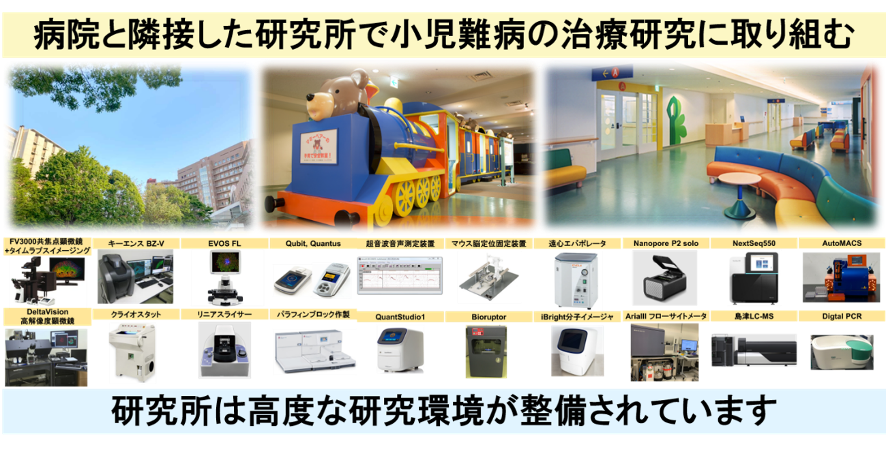
NCCHD is the best research environment with lab and hospital
研究所と病院が一体の理想的な環境です -
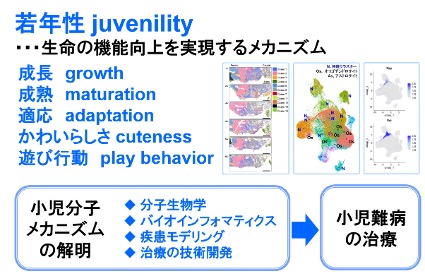
Juvenility is child-inherent property that can be harnessed therapeutically
若年性は小児が生まれながらにもつ特性です -
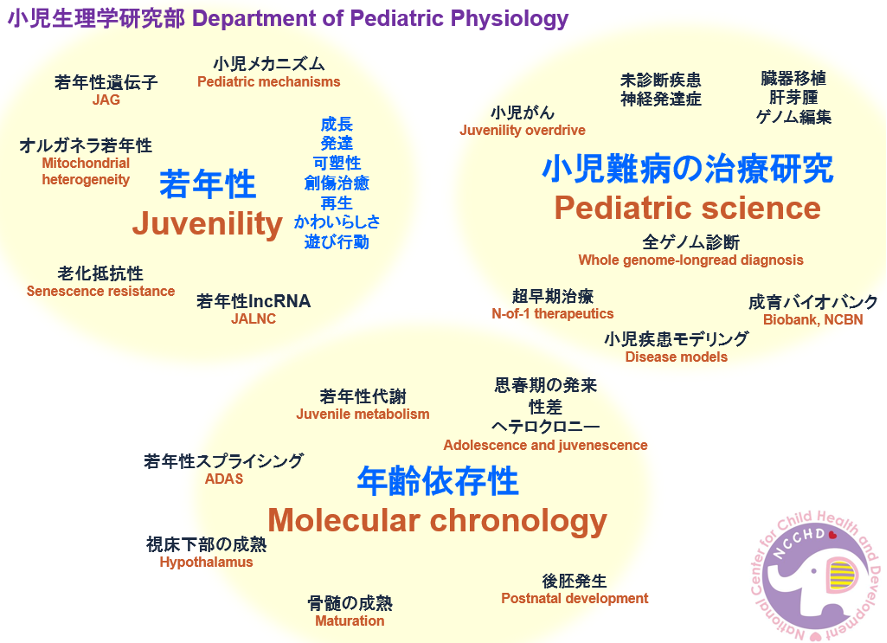
Main bodies of our research interests
研究テーマの主軸です -
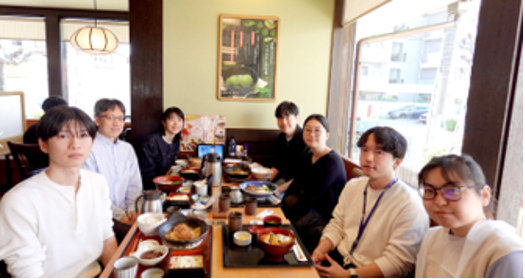
Lunch with lab members
ラボランチの風景です
ARTICLE
Ariyama H, et al. The mTOR-Dop1a-Agpat2 axis regulates nuclear phospholipid homeostasis. iScience. 29(6):115860, 2026
URL:
https://www.cell.com/iscience/fulltext/S2589-0042(26)01235-6
Tsukamura A, et al. KNTC1 introduces segmental heterogeneity to mitochondria. Dis Model Mech. 18(3):dmm052063, 2025
URL:
https://journals.biologists.com/dmm/article/18/3/DMM052063/367265/KNTC1-introduces-segmental-heterogeneity-to
Hibino E, et al. Bex1 is essential for ciliogenesis and harbors the biomolecular condensate-forming capacity. BMC Biol. 20:42, 2022
URL:
https://link.springer.com/article/10.1186/s12915-022-01246-x
Jam FA, et al. Neuroepithelial cell competition triggers loss of cellular juvenescence. Sci Rep. 10:s41598-020-74874-4, 2020
URL:
https://www.nature.com/articles/s41598-020-74874-4
Kadota Y, et al. Srsf7 establishes the juvenile transcriptome through age-dependent alternative splicing in mice. iScience. 23:100929, 2020
URL:
https://www.cell.com/iscience/fulltext/S2589-0042(20)30113-9
